
 |
Prepared by Scott R. Siler
Founder, Exergy International · Creator, Political Risk Demystified
Founder, Exergy International · Creator, Political Risk Demystified
In this issue
Who's hiring · The Houthis Are Not Closing the… · Congress Went Home for the…
20 Added this week 139 still open | Roles per week — last 6 weeks
| ||||||||||||||||||
Postdoctoral Fellow Tulane University · New Orleans, LA |
Assistant Professor in Comparative Politics/International Relations University of Arkansas · Fayetteville, AR |
Assistant Professor in Comparative Politics/International Relations (Populism) University of Arkansas · Fayetteville, AR |
Intelligence Analyst (Temporary) Concentric · Herndon, VA |
Threat Analyst - Russia & Eastern Europe Kforce Inc · New York, NY |
Every political risk role we track, refreshed daily from 24 sources, with an AI application assistant on every listing.
| Browse the board |
|
| POLITICAL RISK SPOTLIGHT |
The Houthis Are Not Closing the Red Sea. They Are Licensing It.
 Perim island in the Bab al-Mandab, with the tip of Yemen's Shaikh Said peninsula above it, photographed from the International Space Station, March 2010. NASA Johnson Space Center, public domain. |
Houthi forces now hold Yemen's entire Red Sea coast. In an offensive this month that routed the Saudi-backed government's troops, they took the port of Mocha, Perim island, the Mayun of last issue, at the southern mouth of the Bab al-Mandab and the Hanish islands to its north, and are pushing on Taiz and the gas fields at Marib. Their military spokesman then set the terms of passage: navigation is safe for every company except Saudi ones. Riyadh answered with hundreds of airstrikes, intercepted a drone approaching Mecca, and lost an F-15 over Marib by the Houthis' account; the Houthis kept firing at Yanbu, where the East-West pipeline terminates and loadings stopped a week ago. The same weekend, US officials sat down with a Houthi delegation at the American embassy in Muscat and came away with a pledge that American, Israeli and commercial ships would not be touched, Saudi vessels excepted.
| — | The chokepoint is discriminating, not closed — the Bab al-Mandab carries roughly a tenth of seaborne oil trade, and the Houthis are offering it to everyone but the one exporter whose Red Sea outlet they have just cut. That is a sanction on Saudi Arabia enforced from the water, not a blockade. |
| — | Washington secured its own passage and declined Riyadh's war — the Muscat meeting, organized by Oman, included the sanctioned Houthi negotiator Mohammad Abdulsalam. Crown Prince Mohammed bin Salman is reported to have asked the President for direct military support and been turned down. Two days later the State Department cleared up to 48 F-35As for the kingdom, $24.3 billion of aircraft that arrive years from now, with a 30-day congressional review still to run. |
| — | The bypass is still down and the buffer is draining — the East-West line remains shut a week after the drone strike from Iraq; Saudi Arabia says it can restore half its capacity within days, the US Energy Secretary says days not weeks, and Yanbu storage has fallen below 15 million barrels from about 21 million in July. Aramco has cancelled late-September cargoes to European refiners, and Saudi barrels are moving instead through Gulf ports and ship-to-ship transfers in the Gulf of Oman with US naval help. |
| — | Iran is running a permit regime of its own in Hormuz — the Revolutionary Guard struck a Togo-flagged tanker for what it called an "illegal passage" while US officials say flows through the strait are back near pre-war levels, with Goldman putting Gulf exports at two-thirds of prewar volume. Both ends of the Arabian Peninsula now have a gatekeeper deciding who transits, and neither gatekeeper is Saudi. |
| — | Riyadh's request went to Beijing — China pressed Tehran to restrain the Houthis at Saudi request, without threatening anything, while Iran's foreign minister was in Beijing and Wang Yi called for Hormuz to reopen "at an early date". Iran's security chief says there is "zero trust" in Washington and no talks until Iran's conditions are met; the President says he has spoken to the Iranians directly and the war is "hopefully toward the end". |
| — | The decision point is next week in New York — the President told Axios he is close to deciding whether to "annihilate" the Iranian regime or not, and that the answer depends on what six Gulf heads of state tell him on the sidelines of the General Assembly. Brent spent the week between $103 and $108, and 125,000 Yemenis have been displaced by the fighting. |
PRDM Analysis Last issue's read was that the pipeline strike removed the second door, and that the premium which came back was a redundancy premium rather than a Hormuz premium. That held: the line is still shut, Yanbu is running down its tanks, and Brent has not been below $100 since. What this week added is the shape of the thing on the other side of the door. The Houthis have not tried to close the Bab al-Mandab, which would unite every shipper and navy against them. They have opened it to everyone except the one state that can no longer reach it, which is the same discriminating instrument Washington uses when it sanctions a single counterparty and licenses the rest. The effect is to split the coalition of the affected. American hulls are covered by a ceasefire renewed in Muscat, European and Asian cargoes are told they are safe, and the whole cost of the Red Sea front lands on Riyadh, which is the one capital Washington has just told to manage its own war. That is why the Saudi request to rein in the Houthis went to Beijing and not to Washington, and why China could answer it for free. A gatekeeper at each end of the peninsula, an F-35 package that is a promise rather than a capability, and a Gulf leaders' meeting that the President says will decide whether he escalates: the structure now is that the United States is negotiating its own exit while its principal Gulf ally is being priced out of both of its coasts. |
Signal Takeaway Organizations that added the East-West line and Mayun to their indicator set last month should now sort exposure by ownership rather than by route. In the Red Sea the risk variable is who owns the hull and the cargo, not which lane it uses; war-risk underwriting will follow the Houthi list, so Saudi-flagged and Saudi-chartered tonnage, Aramco term cargoes and joint ventures that load at Yanbu carry a premium that a Maersk or an MSC box on the same water does not. The Gulf of Oman ship-to-ship zone is a new node with its own security and insurance profile and should be treated as one. Three dates matter more than the price: the Gulf leaders' meeting in New York, which the President has said will set his decision; the Yanbu restart, which tells you whether the redundancy is coming back or being abandoned; and the end of the F-35 review window, which tells you whether Congress is prepared to back Riyadh with anything at all. And note who Riyadh called. If Saudi Arabia is routing its requests through Beijing, so should the analysis of how this front ends. |
Congress Went Home for the Election and Left the President Another Tariff
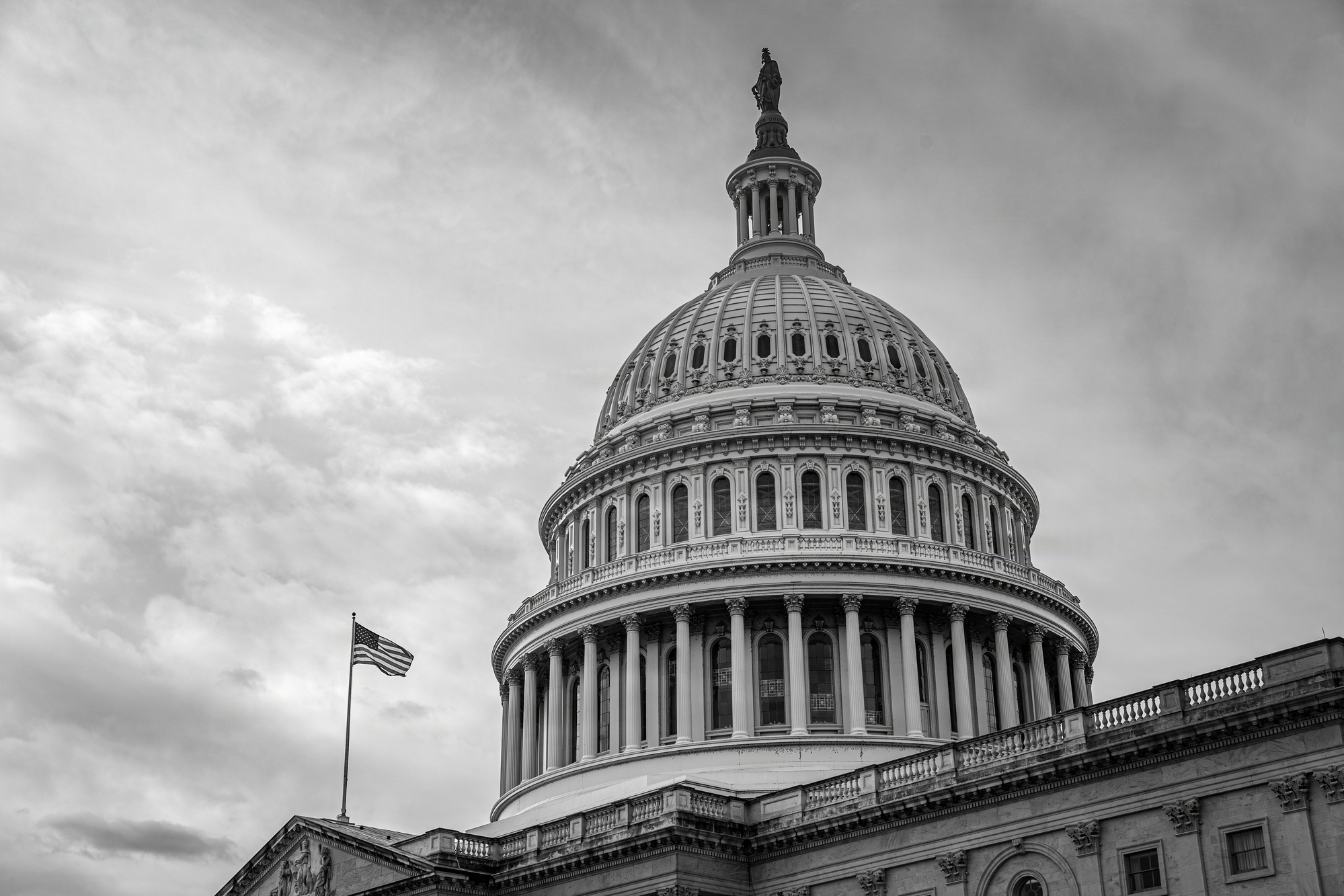 The Capitol dome, Washington, D.C., with a flag flying from the roof below it. The House passed the Graham Act 262 to 159 on its last day in session before November. |
On its last day in session before November, the House passed the Lindsey O. Graham Sanctioning Russia and Iran Act 262 to 159 and sent it to the President's desk. The bill, named for the senator who built it over more than a year and died in July, weeks before it cleared the Senate 86 to 11, lets the President put tariffs of up to 100 percent on the top five buyers of Russian oil and gas, sanctions Russian officials, banks and the shadow fleet, and, at the White House's request, extends Iran sanctions authority for five years. Fifty-eight Democrats voted for it over the objection of their own leadership, who called it a grant of tariff power the President cannot be trusted with. The same afternoon the Federal Reserve raised rates a quarter point to 3.75 to 4 percent, its first hike since 2023, unanimously, under the chair the President appointed; by evening the President was demanding rates of 1 percent "or less".
| — | The instrument is discretionary, which is the point — the bill allows rather than requires the tariffs, exempts countries that take significant steps to cut Russian energy and buy less than 15 percent of Russia's gas exports, and lets the President waive sanctions on a national-interest certification to Congress. House Democrats' complaint was precise: it expands presidential tariff authority while failing to mandate sanctions. |
| — | The targets are India and China, and Xi arrives next week — the top-five list is a China and India list. The President now holds a 100 percent tariff threat he can sign, hold or waive on the eve of a summit at which the White House has already shelved its excess-capacity tariff report and a $14 billion Taiwan arms package. |
| — | The sanctions bill is inflationary and the Fed said why — the chair cited geopolitics, a strong economy and inflation "too high for too long"; the CBO's report the same day put the Iran war's cost at $38 billion, rising $3 billion a month, and its inflation effect at half a point in early 2027. A 100 percent tariff on Indian and Chinese goods, triggered by their Russian crude purchases, would land on the same price index the Fed just hiked against. |
| — | The President voted for the hike and against it in the same day — he says he told the chair to "vote with the board because it's not going to matter", still has confidence in him, and wants rates at 1 percent. That is an instruction to expect cuts from a committee that just tightened 12 to 0. |
| — | The House voted to end the war for a third time and funded nothing — 220 to 204, seven Republicans in favor, three of them for the first time, with no path past a veto. Congress has neither authorized nor appropriated for a war the Pentagon says has cost at least $42 billion, and it will not sit again until after the election. |
| — | Everything until November 3 is now executive — no new authorization, no appropriation, no vote on the tariff, and no hearing on whether the Graham Act is signed, held or waived. Last issue argued that more foreign governments were planning around the midterms than around Washington's own calendar; the House has just made that the only calendar. |
PRDM Analysis The mechanism argument from last issue was that Section 338 replaced slow, public tariff process with an instrument that is instantaneous and reversible, and that under such an instrument a concession and an escalation cost the same. Congress has now added a second one, on purpose, with a 100 percent ceiling and a waiver clause, and aimed it at the two economies the President is about to negotiate with. The Democratic leadership's objection was not that the bill is weak on Russia; it was that a discretionary tariff is a bargaining chip, and a chip is used to trade, not to punish. The Fed decision belongs in the same frame. A central bank citing geopolitics for its first hike in three years is saying that the war and the tariffs are the inflation, and a President who endorses the hike, demands the cut and holds a new tariff power at the same time is describing a policy mix in which every lever pulls against another. What resolves it is not Washington, which has left, but the sequence of the next two weeks: the Xi summit, the Gulf leaders' meeting, and whether the Graham Act is signed before or after both. The bill's authors wanted a sword over Moscow. What they delivered is a sword over New Delhi and Beijing, in the hand of a President who has said arms sales are a bargaining chip and Venezuela's oil paid for the war. |
Signal Takeaway Organizations with Indian or Chinese supply chains should treat the Graham Act as a signed threat from the day it reaches the desk, whether or not it is signed, and should plan against the sequence rather than the statute: a signature before the summit is leverage, a signature after is a scorecard, and a waiver certification is the mechanism to watch for either. Indian counterparties have historically complied with US pressure on Russian and Iranian crude, which makes the more probable path a negotiated reduction rather than a tariff, but that outcome is priced in New Delhi, not Washington. On rates, do not model a tightening cycle or an easing one; model a committee that has demonstrated independence and a President who has said he expects it not to matter, and hedge for both directions through November. For Ukraine exposure, the bill is a negotiating instrument for a settlement rather than a sanctions regime, and its first use, if any, will tell you which. And for anyone waiting on Congress for funding, authorization or oversight of the war, the calendar is empty until November 3. |
From the Community This section runs analysis and work from PRDM members. If you have written something — a piece of analysis, a framework you use, a read on a market you know well — reply to this email with a link. Selected work runs here with your name and a link back to you. New to PRDM? Join the community — it is free, and it is where the work in this section comes from. |
PRDM Pulse Signals shaping the geopolitical environment
|
COURSES
PRDM University Structured training in political risk analysis — frameworks, applied exercises, and a capstone, built from the same material Scott teaches at GWU's Elliott School. Introduction to Political Risk Analysis — $25 Start here. Learn the core analytical frame and find out whether this work is for you. Executive PRA — $297 For leaders who commission analysis rather than produce it: how to evaluate, brief, and act on a risk assessment. PRA Accelerator — $497 The full practitioner track — applied exercises, a capstone assessment, and a certificate you can put in front of an employer. PRDM readers take $100 off the Accelerator with code PRDM100. |
Field Manual
Navigating the Uncertainty Business How to Build a Career in Political Risk Analysis · Scott R. Siler A field manual for professionals building careers in political risk — grounded in judgment, positioning, and decision-making under uncertainty. Built for professionals serious about entering or advancing in the field.
PRDM readers receive 20% off with code PRDM19. |
PRDM Channel
Geopolitics, political risk, career insights Weekly geopolitical briefings and political risk analysis.
|

| LOOKING AHEAD |
Next issue
|
Until next time, Best, Founder, Exergy International | Creator, Political Risk Demystified (PRDM) |
